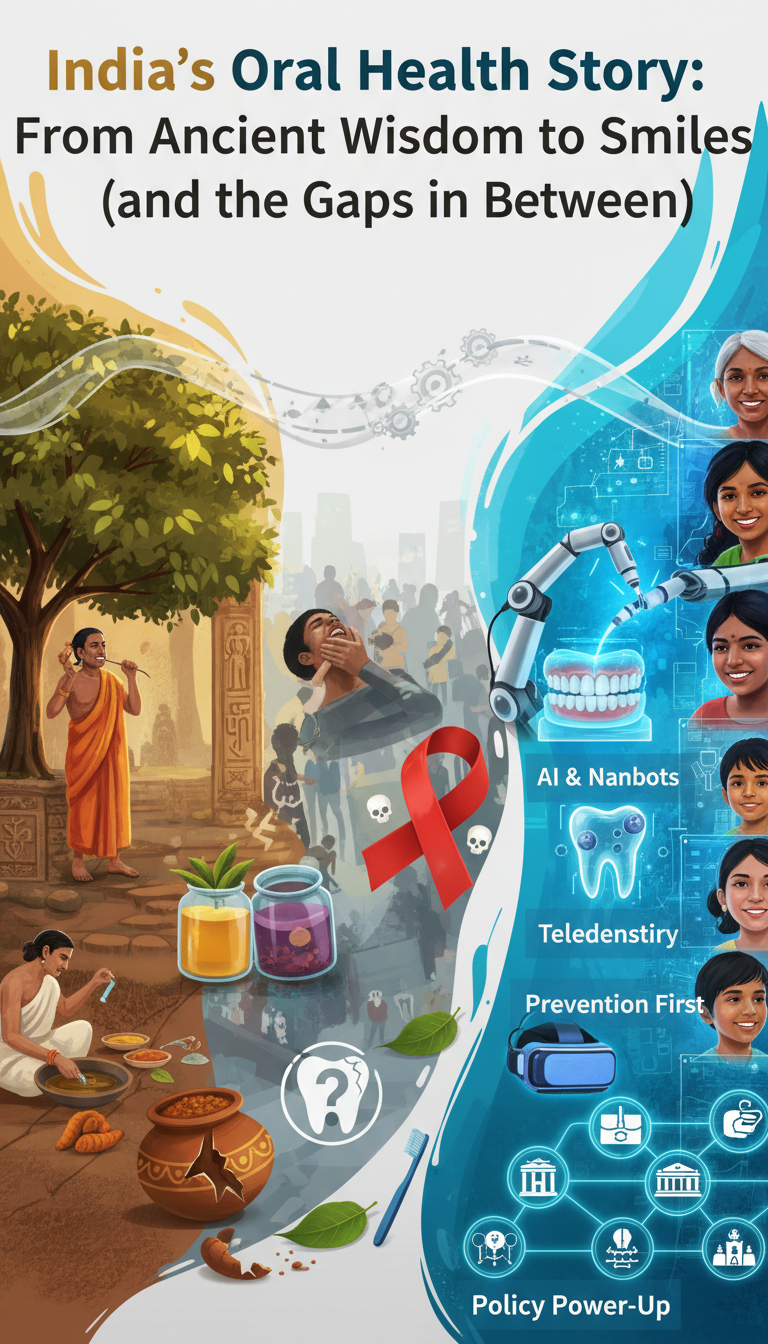
From Ancient Wisdom to Digital Smiles (and the Gaps in Between)
I. Introduction: More Than Just a Pretty Smile – India’s Oral Health Challenge
Ever thought about your teeth beyond brushing twice a day? For billions, oral health is a silent crisis, often overlooked until the pain kicks in. In India, your mouth tells a complex story. We’re talking widespread tooth decay, rampant gum disease, and alarmingly high rates of oral cancer – these issues are actually more common than many major chronic systemic diseases here! It is a paradox, isn’t it? Something so fundamental, so intrinsically linked to our daily lives, is relegated to the periphery.
Oral health isn’t just about teeth; it’s a critical gateway to overall well-being. But in India, it presents a huge, complex public health concern, marked by significant disparities in practices and awareness. One might even argue that the state of our nation’s oral health is a mirror reflecting deeper societal inequalities and a historical neglect of preventative care.
II. Echoes of the Past: Ancient India’s Dental Secrets
Believe it or not, our ancestors were pioneers in dental care! Dating back thousands of years (as early as 7000 BCE in the Indus Sarasvati Civilization), ancient Indian medicine, Ayurveda, had a sophisticated, holistic approach to oral hygiene. Imagine a world without plastic toothbrushes and fluoride toothpaste; a world where nature provided all the necessary tools.
Forget modern brushes! People chewed on medicinal twigs like Neem and Peelu, which naturally released germ-fighting agents. These weren’t just random sticks; they were carefully selected for their medicinal properties. They used concoctions of salt, turmeric, clove, cinnamon, and other herbs for pastes and rubs – natural anti-inflammatories and breath fresheners. It’s a testament to the power of observation and the deep connection our ancestors had with the natural world.
Oil pulling & tongue scraping? These wellness trends are totally ancient Indian! Swishing oils (like sesame or coconut) and scraping tongues were daily rituals for detox, gum health, and fresh breath. These practices were not mere cosmetic procedures; they were integral to maintaining the body’s delicate equilibrium.
The emphasis was proactive and preventive, linking oral health (Danta Swasthya) to the body’s overall balance and doshas. The wisdom of Ayurveda recognized the mouth as a microcosm of the entire body, with imbalances manifesting as oral ailments. Perhaps, in our modern rush for quick fixes, we’ve forgotten the profound wisdom of this holistic perspective.
III. The Tooth of the Matter: Oral Health Today
Fast forward to today, and the collective smile isn’t quite as bright. The uncomfortable truth is that we are facing an oral health crisis.
Tooth decay (dental caries)? It’s everywhere! Over half of Indian children and up to 85-90% of adults battle cavities. Untreated, it’s globally the most common health condition. Gum disease (periodontal disease)? Almost everyone – 50% to a staggering 90-95% of adults – experiences some form of gum trouble. And then there’s oral cancer: India is often called the “world capital of oral cancer,” accounting for over 30% of all cancers in the country, largely fueled by tobacco use. These figures are not just numbers; they represent countless lives affected by pain, suffering, and diminished quality of life.
Many Indians view oral health as less important than general health, waiting for severe pain or discomfort before seeking help. “Desi Nuskas” are often tried first before a dentist is consulted, sometimes delaying proper treatment. Worries about painful treatments, perceived high costs, and strange beliefs (like scaling loosening teeth) keep people away from clinics. It seems we’ve inherited the ailments but lost the preventative mindset of our ancestors.
Dentists largely agree the situation is “somewhat bad” and needs urgent, government-backed initiatives. Lack of public awareness, widespread gum disease, dental caries, and the soaring rates of oral cancer are top challenges. Most dental visits are for emergencies, not routine check-ups, creating a reactive system. We’re stuck in a cycle of treating problems rather than preventing them, a costly and ultimately ineffective approach.
IV. Brushing Up on Habits: A Mixed Bag of Modern & Traditional
How do Indians actually clean their teeth? The answer is a mixed bag of modern aspirations and deeply ingrained traditions.
Only about 45% brush twice daily, significantly less than other nations. A substantial portion (40%) still doesn’t use a toothbrush at all. Interdental cleaning is largely neglected (71.4% never flossed in one study), leading to plaque buildup. Harmful objects like toothpicks and matchsticks are common, risky substitutes. Mouthwash is a low-priority item for most (only ~9% use it). One has to wonder: have we truly embraced modern hygiene practices, or are we simply paying lip service to them?
Chewing sticks (Datoon) are still prevalent in rural areas, offering natural cleaning and antimicrobial benefits from various plant twigs. Salt, charcoal, brick powder, ash are widely used for low cost, but highly abrasive and damaging to teeth and gums. Turmeric, Triphala, Aloe vera are still embraced for their anti-inflammatory and cleansing properties. Betel quid and areca nuts are sometimes used for cleaning, but they are known to stain and are carcinogenic. It’s a paradox of holding onto traditions, some beneficial, others demonstrably harmful, often driven by a lack of access to alternatives.
V. The Cavities of Controversy: Challenges and Disparities
A fundamental issue is the widespread lack of awareness about oral hygiene’s importance and its crucial link to overall health. Many consult non-dentists (like chemists). Dental care is often neglected in India’s public healthcare system, limiting affordable options. Dental treatments are perceived as costly, and most health insurance plans in India don’t cover them (often classifying procedures as cosmetic), creating a huge financial burden. The system seems designed to exclude a significant portion of the population.
Despite a large dental workforce, distribution is heavily skewed towards urban areas. A shocking ~69% of the population lives in rural areas, yet less than 2% of dentists serve them. Think a dentist-to-population ratio as low as 1:250,000 in some rural spots! Limited clinics, inadequate equipment, and staff shortages are rampant in underserved regions. It is a tale of two Indias: one with access to the latest dental technology and another struggling for basic care.
Rampant tobacco consumption (chewing, smoking, paan, betel nut) and increasingly sugary diets are significant contributors to the crisis, particularly driving oral cancer rates. Oral health is often a peripheral consideration in national health policies, lacking a comprehensive, integrated approach within primary healthcare. Due to access and cost barriers, many turn to unqualified, informal dental practitioners – a risky gamble that affects quality of care (only 47% treatments by licensed pros). These are not isolated problems; they are interconnected threads woven into the fabric of our society.
Socioeconomic status, gender (men report more oral pain/work disruption), age (routine visits decline after 35-44), and regional imbalances (e.g., 43% of dental institutes in southern states) all contribute to unequal care. The COVID-19 pandemic led to significant delays or cancellations of routine dental check-ups, worsening untreated issues. It’s a sobering reminder that even in the 21st century, access to basic healthcare remains a privilege, not a right, for many.
VI. Future Smiles: A Glimpse into India’s Dental Tomorrow
The future isn’t all doom and gloom. There’s a glimmer of hope on the horizon, fueled by technological advancements and a growing awareness of the importance of oral health.
Steady adoption of advanced tech like intraoral scanners (replacing goopy impressions), CAD/CAM systems (for quick crowns/bridges), and 3D printing for precise, efficient treatments. The rise of remote consultations, virtual examinations, and e-prescriptions is crucial to bridge accessibility gaps, especially in rural and remote areas. Artificial intelligence will aid in faster, more accurate diagnosis (e.g., early cancer detection). Even magnetic nanobots (“CalBots”) are being developed to repair teeth! Technology is democratizing access and empowering both dentists and patients with new tools.
A significant shift towards effective home care, patient education, regular professional check-ups, and minimally invasive procedures (like laser dentistry). A growing understanding of the connection between oral health and overall well-being, incorporating nutrition, stress management, and lifestyle into dental care. We are finally beginning to understand that oral health is not an isolated entity but an integral part of a holistic approach to well-being.
The National Oral Health Programme (NOHP) for integrated care, the National Dental Commission Bill 2023 (overhauling education and standards), Danta Bhagya Yojana (free dentures for seniors), and linking oral health to broader missions like Ayushman Bharat and Swachh Bharat. The Indian Dental Association (IDA) drives campaigns (“Swachh Mukh Abhiyaan,” Tobacco Intervention Initiative), oral cancer foundations, and national surveys. NGOs like OHPF focus on school programs and mobile clinics. It’s encouraging to see both governmental and non-governmental organizations stepping up to address the challenge.
Public-private partnerships are crucial for expanding service delivery, especially in underserved areas, and making care more affordable and accessible. Dental education is evolving with more “real-life” training, soft skills courses, increased research, and potentially mandatory rural postings for new graduates. The dental industry is also moving towards greener practices and eco-friendly technologies. The future demands a collaborative approach, where innovation, education, and sustainability converge to create a healthier future for all.
VII. Conclusion: A Brighter, Healthier Smile for All of India?
India’s oral health journey is a fascinating blend of ancient wisdom, present-day struggles amplified by disparities and lack of awareness, and a promising future driven by technology and policy changes. The path forward is multifaceted.
Achieving optimal oral health for all Indians requires a collective effort – from individuals adopting better hygiene, to sustained government initiatives, improved dental education, and technological leaps. It’s a shared responsibility, a social contract between individuals, communities, and the state.
The goal isn’t just to fix problems when they arise, but to prevent them altogether, fostering a culture where a healthy mouth is truly recognized as a cornerstone of a healthy life. Perhaps, by rediscovering the preventative wisdom of our ancestors and embracing the innovations of the future, we can finally bridge the gaps and create a nation where everyone has a reason to smile.